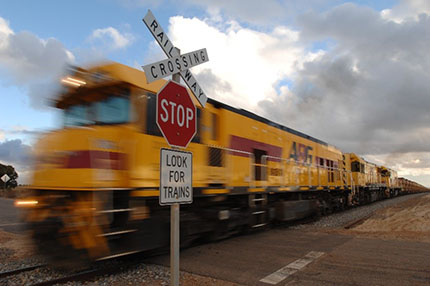
Rail transportation
Although railways are a product of the industrial revolution, they have been affected by continuous innovations, technical, regulatory, and commercial changes, which have improved their capacity and efficiency. One innovation relates to the quality of the rail infrastructure, particularly rail tracks (e.g. better steel, concrete ties), which determines the operational characteristics of their use, such as speed, permitted weight, maintenance, and resilience to the environment.
Increasing electrification and automation also improve the efficiency of rail transportation, passenger, and freight alike. A few new rail lines are being built, but mainly in developing countries. Railway speed records have improved continuously with the introduction of high-speed rail systems. For instance, portions of the French high-speed rail system (also known as TGV: Tres Grande Vitesse) can reach speeds up to 515 km/hr. Variable wheel-base axles permit rail transport between different gauges. However, freight trains run at a considerably lower speed, in the range of 30-35 km/hr. In some cases, as the rail system gets more used, operational speed may decline because of congestion.
The global trend involves the closure of unprofitable lines as well as the elimination of several stops. With the downsizing of rail transportation, while traffic was moving to other modes, rail companies abandoned lines (or sold them to local rail companies), removed excess terminals and warehousing capacity, and sold off some property. The process of rationalization (deregulation) of the rail network is now completed in several countries, such as the United States. This has implied significant labor savings with the reduction of train crews (from 3-4 to 2), more flexible working hours, and the usage of subcontractors for construction and maintenance. In addition to energy efficiency (the fuel efficiency of locomotives has increased by 68% between 1980 and 2000) and lighter equipment, the usage of double-stack cars has revolutionized rail transportation with additional fuel efficiency and cost reductions of about 40%. Depending on the service and type of commodity carried, rail can be 1.9 to 5.5 more energy-efficient than trucking. Unit trains, carrying one commodity-type only, allow scale economies and efficiencies in bulk shipments, and double stacking has greatly promoted the advantages of rail for container shipments.
Author
EkaRelated posts
Rail terminals
Rail terminals are facilities used for the transfer of passengers and freight to
Australia: marching towards a lower carbon future
With sustainability now viewed as an ethical norm and an important part of busin
Decision making
Sometimes driving S&OP towards decision making is challenging, with meetings oft