Rail Vehicles
Rail transportation, like roads, has an important relationship with space since it is the transport mode the most constrained by physiography. These constraints are mainly technical and operational:
- Footprint
- Gradient and turns
- Vehicles
- Gauge
- Vertical intergration
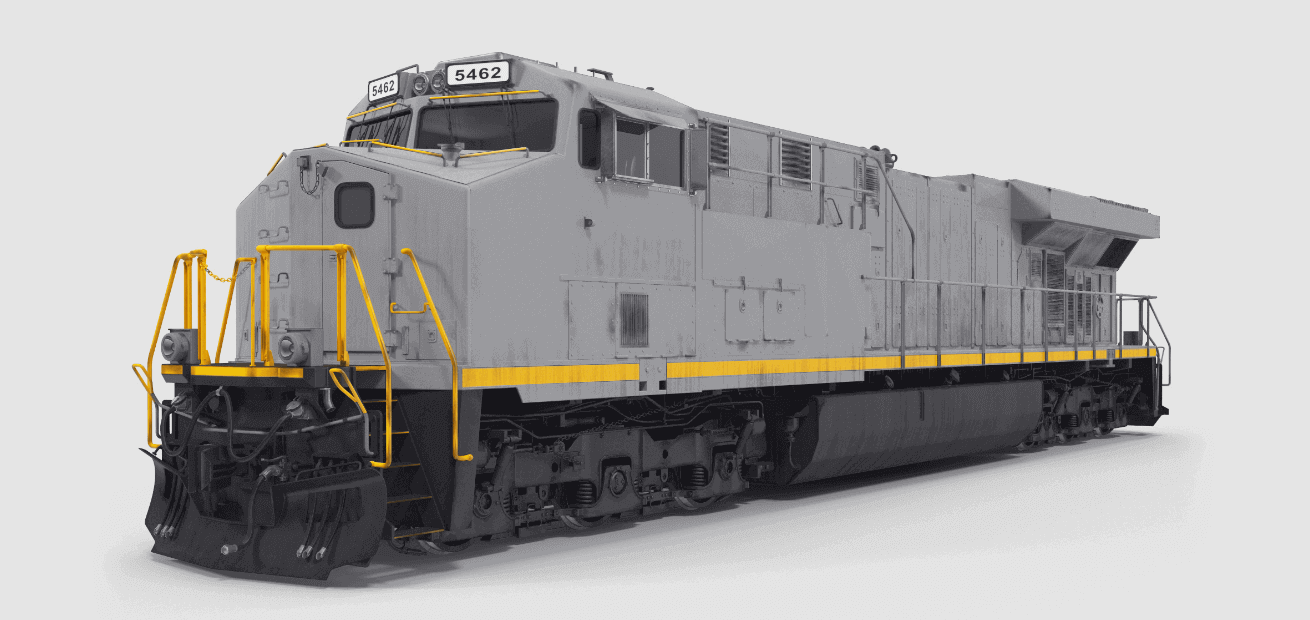
Rail vehicles have very different bogies compared to road vehicles. While railway vehicles initially ran on two or three fixed axles, the bogie, originally called the “swivelling bolster”, was soon generally accepted. It is a short two or three axle unit which is mounted under the vehicle frame so that it is free to move to a certain extent.
The same applied in the development of motive power units, which in the main are designed as bogie vehicles today. Fixed – but sideways displaceable for running in curves and by means of the suspension radially adjustable to a small measure – wheel sets are still fitted to small locomotives, shunters, freight wagons and of course many historic vehicles.
Rail vehicles are: locomotives, wagons and carriages.
For traction, locomotion technology ranges from steam (abandoned) to diesel (mainly for freight) and electric (primarily for passengers). Rail transportation is very flexible in terms of vehicles, and there is a wide variety of them filling different purposes. Among the most common vehicle assets are open wagons (hopper cars) used for bulk cargo (e.g. minerals), boxcars to carry general and refrigerated goods, and tank cars to carry liquids. Intermodal transportation has also permitted the development of a new class of flat railcars that can carry containers and trailers (less common). The trend has thus been towards a specialization of freight wagons, such as hopper wagons (grain, potash, and fertilizers), triple hopper wagons (sand, gravel, sulfur, and coal), flat wagons (wood, agricultural equipment, manufactured goods, containers), tanker wagons (petrochemical products), box wagons (livestock, paper, manufactured goods, refrigerated goods), car wagons and passengers wagons (first class, second class, third class cabins, sleeper cars, restaurant cars).
The wheelsets of bogies are mounted so that they can turn in a bogie frame that is fitted under the main frame, which is advantageous for many reasons:
- Firstly, the bogie can turn relative to the mainframe whenever it runs round a curve. The small wheelbase allows the vehicle to traverse tighter curves (thus those with smaller radii) than would be possible with two rigid wheelsets without constraint. Consequently, it is possible to design longer vehicles and the length is only limited by the loading gauge profile in curves.
- The second advantage is the achievable bogie riding: The unavoidable vertical and transverse impacts on the track are first of all balanced out in the bogie and only weakened (halved) forces are transferred to the main frame.
- In addition, the axle loads in bogies are reduced compared to an individual axle. Together with the better running in curves this can lead to significantly reduced wear on railway track.
Apart from the basic properties, bogies for locomotives, railcars, passenger coaches and freight wagons, as well as underground and suburban vehicles are, however, designed differently. Only in this way can all the requirements for speed and comfort, load carrying capacity and axle load, safety against derailment and smooth running be achieved. There are an almost incalculable number of different designs of bogies. On closer consideration it also appears that many road-rail vehicles and even maglev vehicles run on special bogies.
Railway bogies generally run on two or more wheelsets. There are rare cases of single axle and so-called loose wheel bogies, which of course require a special mechanical activation for running in curves. Four and more axle bogies are generally formed from groups of two or three axle frames because of the length produced by normal wheel diameters. They are in turn carried in a common likewise rotatable bridge frame.
Author
EkaRelated posts
A Sustainable Future
The new data science and engineering team is already making a difference in area
Strategies
Strategies - Enhancing freight forwarding operations As a widely recognised name
Expert Tips
Maritime and Ocean Transport is a huge and highly complex industry. It’s estim